
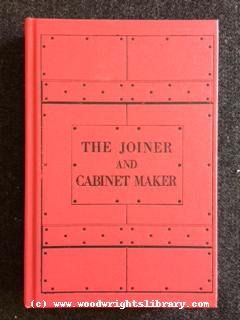

This book roughly follows the apprenticeship of a young boy named Thomas. The book provides some hints at what the role of a joiner's apprentice all entailed. Eventually, Thomas is given some projects: a packing box, a small storage (school) box, and a chest of drawers. For each project the author explains the construction details. For the packing box there is some explaination of using clinched nails as well as some details on squaring up stock. Thomas uses dovetails for the construction of the school box and further details how to install hinges as well as a lock. The Final project, the chest of drawers, details a few more joinery skills such as rabate/rabbit joints, frame and panel construction with mortice and tenon joints, and dovetails blind of one eye (i.e., half blind dovetails). The unknown author of the original text goes on to explain that this chest would have likely been finished with a faux oak finish. However, the original text goes on to explain that the same chest could easily be veneered and then french polished. In fact the text even describes a varnish/polish recipe.
The modern authors have further added to the original text. They have provided some historical context for what the joinery trade may have looked like in Thomas' day. Further, nearly two thirds of the book are detailed construction notes for the three projects described in the original text.
Even though I have not tried to build any of the projects in this book I have found the modern construction details to be fairly useful. In some ways the benefit of an apprentice ship is the ability learn skills through observation of other more experience people exhibiting those skills. As a hobbist/amature woodworker it is not practical to become an apprentice. For this reason I think the modern construction details in this book are valuable to woodworkers like myself that rely on books and videos to develop our skills.
This book is a little difficult to find a direct comparison. Like other Lost Art Press books (i.e., The Art of Joinery and To Make as Perfect as Possible) this book has some valuable modern addations that complement the original text. However, I have yet to really read anything that I would directly compare to this book's content.
One of the modern sections of this book mentions that this book is a bit different in that Roubo was far more of an advanced how-to book while Moxon and Nicholson where targetted more towards gentelmen that were curious on how things were not (as in they don't provide enough detail to actually be a how-to book). This book on the other hand was more targetted to explain what a joiner's apprenticeship. Occassionally, the modern authors have added some foot notes that reference other apprenticeship experiences but I am not familiar with those other writings to be able to draw direct comparisons at the moment.
I found this book fairly interesting. Reading about the life of an apprentice and roughly what it was like to be a joiner during Thomas' day was interesting. I also found the modern construction details to be interesting since I picked up a few dovetailing and joinery tips that I will try out when I get a chance. I would generally recommend this book but would want to reiterate that this is not a how-to book. If you are looking for more of a how-to book focused on hand tools I would suggest the 4 volume set of The Practical Woodworker.
Pages: 370 Publisher: Lost Art Press ISBN-13: None