
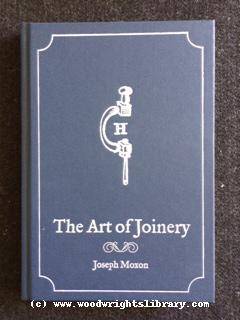

This is a very interesting book to read. It is one of the earliest known books to detail the tools and tasks of joinery work. The text is actually in the public domain and many free digital versions can be downloaded from Google Books and Hathi Trust Digital Library, however, I recently purchased a hard copy reprint version from Lost Art Press. The version I have is actually a revised edition of their first reprinting on Joseph Moxon's The Art of Joinery which is one of multiple Mechanick Exercises from Moxon's similarly named book.
Roughly a year ago I did read through the entirety of the Mechanick Exercises which included sections on blacksmithing, carpentry, bricklaying, turning, as well as sundial making. The original , old English, text was amusing to read through and I recommend anyone interested in reading this book to give the old English version a try. However, the Lost Art Press version has included an updated version of the text (along with the original text) which is a bit easier to read.
A valuable contribution of this updated version is the placement images near the actual description text. Books of this era printed any graphics on separate pages (or plates). However, since the text primarily reference images to the tools being described this forces the reader to be flipping back and forth from the text to the images. Lost Art Press did a great job (and service) to include the referenced images near the actual sections of text that describe them.
This Lost Art Press version also has provided commentary related to each section of text. I found this commentary very enlightening since it highlighted details that I would have otherwise glossed over. In fact many of these details I glossed over even though this was the second time reading Moxon.
Despite all the praises I will however highlight a few drawbacks. First, as far as Moxon in general; the text doesn't provide a great reference from which to learn joinery. Some of the techniques described have been improved upon this since the late 1600s and some techniques replaced all together. Moxon's text isn't perfect either, there are a few typos and since it is believed that he was merely observing actual craftsmen, there are some facts that are disputed today. That said Moxon still provides an interesting historical reference of the tools and techniques used during his day. Finally, regarding this particular revised edition of the text the one draw back is due to a person preference and a particular publishing method of adding torn page edges. Personally, I find this type of page edge difficult to turn and could have done without.
There are a number of books that have focused on describing the various tools used in the woodworking trade. I, however, don't think the value of Moxon is in the simple description of the tools but instead of the historical account. Moxon is often compared with Randle Holme's The Academy of Armory (1688), and subsequently often referenced in the Lost Art Press revised edition.
I would recommend this book to anyone really interested in the history of woodworking but before purchasing a hard copy of this book it is probably worth the time to browse through a free digital edition of the book. I do highly recommend the hard copy since I found the commentary to be enlightening and interesting.
Pages: 168 Publisher: Lost Art Press ISBN-13: 978-0-9850777-7-8